Friday, October 11, 2019

Brazil - The Seamstress

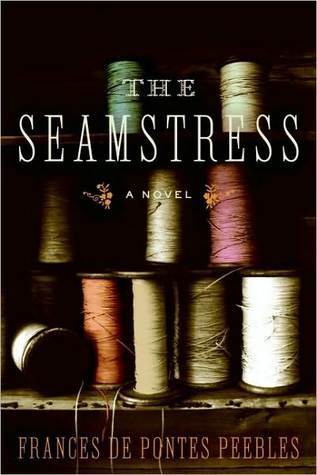
Book #23: The Seamstress - Frances de Pontes Peebles


"As seamstresses, the young sisters Emilia and Luzia dos Santos know how to cut, how to mend, and how to conceal. These are useful skills in the lawless backcountry of Brazil, where ruthless land barons called 'colonels' feud with bands of outlaw cangaceiros, trapping innocent residents in the cross fire. 

Emilia, whose knowledge of the world comes from fashion magazines and romance novels, dreams of falling in love with a gentleman and escaping to the big city. Luzia also longs to escape their little town, where residents view her with suspicion and pity. Scarred by a childhood accident that left her with a deformed arm, the quick-tempered Luzia finds her escape in sewing and in secret prayers to the saints she believes once saved her life.

But when Luzia is abducted by a group of cangaceiros led by the infamous Hawk, the sisters' quiet lives diverge in ways they never imagined."


__

Hey blog! It's been a while! I started reading this book in June. And then I spent the rest of the summer moving from Colorado to Los Angeles. I'm now settled and back to reading. 

I loved this book. Absolutely loved it. The storyline reads as a little bit tired. Another book about two sisters, one who likes traditional things, the other who loves adventure. One who's submissive, one who takes no shit. Been there, done that. And superficially, yes, that's the storyline here. And I admit that it took me a while to care all that much about Emilia, the traditional/submissive sister. But my love for Luzia kept me coming back to the book. And, in the end, Emilia won me over too. 

It's also a great piece of historical fiction. Cangacieros did rule the backcountry of Brazil in the 1920s-30s. There really was a revolution. And a drought. And, of course, The Great Depression. There was also something happening in Germany around that time, and it makes a somewhat surprise appearance in the trajectory of Brazil. I want to know more about this era in Brazil, and I really want to know what happened next... 


Wednesday, June 12, 2019

Botswana - Maru

Book #22: Maru - Bessie Head


"Margaret Cadmore, an orphaned Masarwa girl, comes to Dilepe to teach, only to discover that in this remote Botswana village her own people are treated as outcasts. In the love story and intrigue that follows, Bessie Head brilliantly combines a portrait of loneliness with a rich affirmation of the mystery and spirituality of life."

__

Margaret Cadmore is an orphan who was raised by a the wife of a missionary (also named Margaret Cadmore). Margaret is a Marsawa, an untouchable. When she arrives in the village of Dilepe, ready to teach at the school, the villagers at first assume that she is "a coloured" - which seems to translate into a biracial person. This would be bad, but not nearly as horrible as being an untouchable. When she tells Pete, the principal of the school, that she is a Marsawa, he assumes that the village elders, specifically Maru and Moleka, will demand that she be fired, as they would not allow someone of her low status to teach in their school. But Pete's plans to fire Margaret hit a snag when he realizes that the most respected teacher at the school, Dikeledi, has befriended Margaret. I'm going to stop describing the plot at this point, because I don't want to give it away. But add politics, spirituality, superstition, love, sex, and betrayal (not necessarily in that order), and you've got "Maru." 

I thoroughly enjoyed this short but expansive book! 

Tuesday, June 4, 2019

Bosnia and Herzegovina - How the Soldier Repairs the Gramophone

Book #21: How the Soldier Repairs the Gramophone - Saša Stanišić


"For young Aleksandar - the best magician in the non-aligned states and painter of unfinished things - life is endowed with a mythic quality in the Bosnian town of Višegrad, a rich playground for his imagination. When his grandfather dies, Aleks channels his storytelling talent to help with his grief. 

It is a gift he calls on again when the shadow of war spreads to Višegrad, and the world as he knows it stops. Though Aleks and his family flee to Germany, he is haunted by his past - and by Asija, the mysterious girl he tried to save. Desperate to learn of her fate, Aleks returns to his hometown on the anniversary of his grandfather's death to discover what became of her and the life he left behind."

__

I both loved and struggled to get through this book. I struggled, because much of the book is told from Aleksandar's childish POV. And it's often really hard to follow. Characters don't always have names, they have descriptions (ex: The Three-Dot-Ellipsis-Man, who speaks...like...this...). And trying to figure out how some of the characters relate to the main character and/or the overall storyline is frustrating at times. 

Eventually, I started skimming over those parts of the story and focused on the main themes: A young Bosnian boy, whose mother is Muslim, has to flee his small hometown during the 1992 Bosnian war. Along the way, he meets a young girl named Asija, a fellow refugee, who is hiding in the same cellar. Their families get separated, but Aleks never forgets her. Over the next 10 years, he sends her letters - though he doesn't know her last name. And then he tries calling random numbers, hoping to find her. Does he succeed? Guess you'll have to read the book to find out.  

Sunday, May 5, 2019

Bolivia - American Visa

Book #20: American Visa - Juan De Recacoechea


"Armed with fake papers, a handful of gold nuggets, and a snazzy custom-made suit, an unemployed schoolteacher with a singular passion for detective fiction sets out from small-town Bolivia on a desperate quest for an American visa, his best hope for escaping his painful past and reuniting with his grown son in Miami.

Mario Alvarez's dream of emigration takes on a tragicomic twist on the rough streets of La Paz, Bolivia's seat of government. Alvarez embarks on a series of Kafkaesque adventures, crossing crooked politicians, crossing paths with a colorful cast of hustlers, social outcasts, and crooked politicians - and initiating a romance with a straight-shooting prostitute named Blanca. Spurred on by his detective fantasies and his own tribulations, he hatches a plan to rob a wealthy gold dealer, a decision that draws him into a web of high-society corruption but also brings him closer than ever to obtaining his ticket to paradise."

____

The book tries. It tries to do more than it does, but it's just not well-written. It could be about crooked politicians and the political and economic realities of trying to get a visa and get out of Bolivia. Instead, it's a dime store detective/crime novel, with a touch of local color. Meh. 


Wednesday, May 1, 2019

Bhutan - The Circle of Karma

Book #19: The Circle of Karma - Kunzang Choden


"...tells the story of Tsomo, a fifteen-year-old girl caught up in the everyday realities of household life and work. But when her mother dies, Tsomo suddenly feels called to travel and sets off toward a faraway village to light ritual butter lamps in her mother's memory. Her travels take her to distant places, across Bhutan and into India, evolving into a major life journey. As she faces the world alone, Tsomo slowly begins to find herself, growing as a person and as a woman."

__

I selected this book for a couple of reasons - first, it's the first English-language novel written by a Bhutanese woman. Second, Kunzang Choden has a BA in Sociology from the University of Nebraska-Lincoln, my alma mater. She was born and spent her childhood in Bhutan, then moved to India, got her degree at Nebraska, and then moved back to Bhutan, first teaching and then working for the UN. 

The book takes place in the 1950s, during a period of modernization in Bhutan. Tsomo is from a small village, and her family adheres to very restrictive, traditional gender roles. Her father is a gomchen - a lay Buddhist priest - and he runs a school for the village boys. Tsomo regularly asks him to teach her to read and write, but he refuses. So she takes on traditional duties, marries, and generally does whatever is expected of her. But then she has a miscarriage. And her husband starts cheating on her with her sister. And the "correct" thing to do would be to silently allow it. And she does, at first. 

This book introduces a totally foreign version of Buddhism. This is not the open, accepting, nice version we know here in the West. This book shows Buddhism in its ugly orthodox form. It looks a LOT like evangelical Christianity, honestly. Especially in the defined gender roles. When Tsomo's husband cheats on her, that's a manifestation of her bad karma. It's her fault. She caused it, either in a previous life or in this one. She gets sick - also her fault. Suck it up and burn off that bad karma, Tsomo! (Note: this is never the case for the men. Anything bad that happens to them is caused by the bad karma of someone else, usually a woman.) Thankfully, she meets a progressive Rinpoche who helps her find a different path. 

I knew nothing about Bhutan prior to reading this book, and I feel like I learned a lot. I certainly know more about the less favorable aspects of Buddhism, which often gets idealized in the US, and maybe shouldn't. 


Thursday, March 28, 2019

Benin - Snares Without End

Book #18: Snares Without End - Olympe Bhêly-Quenum


"A novel, also a philosophical tale in which destiny entraps the innocent protagonist and holds him fast. A man's life is ruined when he is unjustly accused of adultery."

___

There aren't many reviews of this book out there, but the few that exist tend to agree - this is really two books, one that should have been published, and one that maybe shouldn't have been. The first half of the book is great. It's an engaging look at rural life in post-colonial Benin. Life isn't particularly easy for Ahouna Bakari and his family, they repeatedly encounter hardships - from locust plagues to forced labor - but they persevere and even thrive. Then Ahouna meets Anatou, a woman from a nearby farm. And at first, everything is great. Their families get along. They have children. Their farms have successful harvests. And then the second half of the book happens, and everything goes completely off the rails. Anatou accuses Ahouna of adultery. She has no reason to do this - I mean, her character has no reason. There is no explanation given, either for why she would suspect him or for why she may have lost her grip on reality. And Ahouna's life goes into a ridiculous downward spiral that also makes no sense, given the character's previous development. 

The first half of the book is really interesting and I learned a lot about Benin. The second half was frustrating and frankly made me angry because both Ahouna and Anatou were ruined. 

Tuesday, March 12, 2019

Belize - The Festival of San Joaquin

Book #17: The Festival of San Joaquin - Zee Edgell


"Luz Marina, cleared of murdering her brutal husband, is released from prison on a three-year probation. Determined to rebuild her life and gain custody of her children, she perseveres, sustained by mother's love and her faith in God in her battle against the poverty, guilt, vanity, and vengeance that threaten to overwhelm her."

--

This book is full of many large themes, most of which are secondary plot points - environmental profiteering, wealthy landowners and a subservient peasant class, colonialism, and an evangelical church that both helps and exploits. All of those form the backdrop to the central story, about a poor woman who murders the father of her children (he's not actually her husband, which is part of the story as well). He, in turn, was the son of her former employer, a wealthy landowner - who treated her terribly and holds the keys to her future. While the central theme of the wronged woman could certainly have taken place anywhere, the various issues circling around her were very specific to Belize. Or, at least, to that part of Latin America. Well worth the read!