Thursday, January 30, 2020

Cameroon - The Poor Christ of Bomba

Book 29: The Poor Christ of Bomba - Mongo Beti


"In Bomba the girls who are being prepared for Christian marriage live together in the women's camp. Gradually it becomes apparent that the local church men have been using the local girls for their own purposes."
__

Sure, the book is about that. But first, you have to suffer through over 100 pages of the narrator talking about following the priest while he travels from village to village, judging everyone for not being pious enough (read: not giving the church/him enough money) and damning them all to hell. And throughout this journey, the narrator is fully supportive of the priest. So supportive, in fact, that nearly every sentence is an exclamation. But I digress. Eventually, the narrator tires of the priest. It happens sometime after a village woman gives the narrator a handjob and he falls in love with her. By the time they return to the main village, everyone has figured out that the priest is a sleaze who has been forcing women into slave labor in exchange for agreeing to perform Catholic marriages. 

This was not one of my favorites. To say the least. 

Monday, January 20, 2020

Cambodia - First They Killed My Father

Book 28: First They Killed My Father: A Daughter of Cambodia Remembers - Loung Ung


"One of seven children of a high-ranking government official, Loung Ung lived a privileged life in the Cambodian capital of Phnom Penh until the age of 5. Then, in April 1975, Pol Pot's Khmer Rouge army stormed into the city, forcing Ung's family to flee and, eventually, to disperse. Loung was trained as a child soldier in a work camp for orphans, her siblings were sent to labor camps, and those who survived the horrors would not be reunited until the Khmer Rouge was destroyed."

__

This is an extremely well-written book about a part of the world and a time in history that is glanced over in most American history books. We've all heard of Pol Pot and the Khmer Rouge and we all have a vague sense that they were terrible. We also seem to leave out the part about the Vietnamese being the good guys in this story. Go figure. 

It's not an easy read. War and genocide never are. But Loung's story is powerful and important. You should read this one even if you're not doing an around-the-world challenge. 

Sunday, January 12, 2020

Cabo Verde - The Last Will & Testament of Senhor da Silva Araujo

Book 27: The Last Will & Testament of Senhor da Silva Araújo - Germano Almeida


"Everyone in Cape Verde knows Señor da Silva. Successful entrepreneur, owner of the island's first automobile, a most serious, upright, and self-made businessman, Señor da Silva is the local success story. Born an orphan, he never married, he never splurged; one good suit was good enough for him; and he never wandered from the straight and narrow. Or so everyone thought. But when Señor da Silva's 387-page Last Will and Testament is read aloud; a marathon task on a hot afternoon which exhausts reader after reader; there's eye-opening news, and not just for the smug nephew so certain of inheriting all Señor da Silva's property. With his will, Señor da Silva leaves a memoir that is a touching web of elaborate self-deceptions."

__

I wouldn't call it a "touching" web of elaborate self-deceptions. Señor da Silva is supposed to be a sympathetic character. I think. I didn't find him to be. He was pretentious, self-absorbed, and, frankly, a rapist. That little bit is entirely glossed over. But anyway. He also died utterly alone. So that's something, I guess. Thankfully, most of this short book is more about other people and their relationships with and lives after Señor da Silva, because that guy was terrible. 

Not my favorite book. Obviously.

Friday, January 3, 2020

Burundi - Small Country

Book 26: Small Country - Gaël Faye


"In 1992, Gabriel, ten years old, lives in Burundi in a comfortable expatriate neighborhood with his French father, his Rwandan mother, and his little sister, Ana. In this joyful idyll, Gabriel spends the better part of his time with his mischievous band of friends, in a tiny cul-de-sac they have turned into their kingdom. But their peaceful existence will suddenly shatter when this small African country is brutally battered by history."

__

Burundi lies at the southern border of Rwanda. 85% of its population is Hutu, 15% are Tutsi, and less than 1% are indigenous Twa. So when the Rwandan genocide broke out in 1994, it didn't take long for the violence to spill over the border into Burundi. 

The novel begins in 1992, in a peaceful Burundi. Young Gabriel has a fairly normal life, though not one entirely without difficulty. His father is French, an upper middle class businessman. His mother is a Rwandan refugee, with many relatives still living in Kigali. They own land, have a cook, a maid, and a driver. But soon his mother's family in Rwanda warns them of coming atrocities and Gabriel's world starts to change. He resists the changes - he doesn't believe that anything bad can or will touch him in the safe confines of his town, his street. He escapes first into his friendships and then into books. But the war finds his town, his friends, and then his family. 

This book is so good. It's terrible in its reality, but I'll be honest - I didn't know the Rwandan genocide extended beyond the borders of Rwanda. This small book about a small country should go on everyone's to-read list. 


Monday, December 23, 2019

Burkina Faso - The Parachute Drop: Norbert Zongo

Book 25: The Parachute Drop - Norbert Zongo


"...the story of a corrupt African dictator toppled in a coup d'état, who seeks to restore his presidency." 

This novel is about a fictional country and a fictional dictator. However, Norbert Zongo was an outspoken critic of Burkina Faso's president, Blaise Compaoré, and Compaoré had Zongo arrested, beaten, and ultimately, assassinated following the publication of this novel. 

So what did Compaorê find so objectionable? I suppose no dictator is a fan of books about overthrowing dictators. In "Parachute Drop," the army of fictional Watinbow overthrows the tyrannical President Gouama, who had taken over following the decolonization of the country. President Gouama survives the coup, but then struggles to get to safety...only to find that his friends have all turned against him. 

This is a short, interesting read about oppressive regimes that took over many African countries following decolonization. 

Monday, November 25, 2019

Bulgaria - Border: A Journey to the Edge of Europe

Book 24: Border: A Journey to the Edge of Europe - Kapka Kassabova


"...Kapka Kassabova returns to Bulgaria, from where she emigrated as a girl twenty-five years previously, to explore the border it shares with Turkey and Greece. When she was a child, the border zone was rumored to be an easier crossing point into the West than the Berlin Wall, and it swarmed with soldiers and spies. On holidays in the 'Red Riviera' on the Black Sea, she remembers playing on the beach only miles from a bristling electric fence whose barbs pointed inwards toward the enemy: the citizens of a totalitarian regime.

Kassabova discovers a place that has been shaped by successive forces of history: the Soviet and Ottoman empires, and, older still, myth and legend. Her exquisite portraits of fire walkers, smugglers, treasure hunters, botanists, and border guards populate the book. There are also the ragged men and women who have walked across Turkey from Syria and Iraq. But there seem to be nonhuman forces at work here too: This densely forested landscape is rich with curative springs and Thracian tombs, and the tug of the ancient world, of circular time and animism, is never far off."

___

I struggled to get into this book. Parts of it were, indeed, enthralling. But it's written almost as a bunch of short stories, as Kapka travels across Bulgaria and meets different people, so just as one group comes into focus, she moves on to the next village. It just seems really uneven - some of the stories were horrifying, some magical, some just plain boring, and some were in between. I never knew what I was going to get from one chapter to the next, which made it hard to return to. 

That said, I came to this book knowing nothing of Bulgaria's history, or its present. It's one of those little European countries that kind of gets lost in the shuffle. But it has an important story to tell. The stories of the immigrants and refugees were particularly catching. And I admit that I wasn't aware of the stories of East German refugees and the horrors that they experienced, trying to escape to the West. The Berlin Wall fell when I was 11. And up until the day it fell, there were people trying to escape via the forests of Bulgaria - and there were Bulgarian citizens who had to choose between turning them in or being imprisoned or killed if they let them go. I had no idea. That knowledge alone makes this book a worthwhile read. But it does much more than that. Bulgaria. 

Friday, October 11, 2019

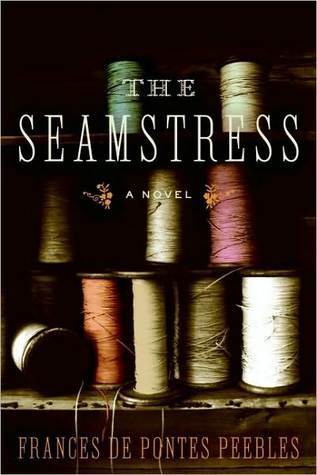
Brazil - The Seamstress

Book #23: The Seamstress - Frances de Pontes Peebles


"As seamstresses, the young sisters Emilia and Luzia dos Santos know how to cut, how to mend, and how to conceal. These are useful skills in the lawless backcountry of Brazil, where ruthless land barons called 'colonels' feud with bands of outlaw cangaceiros, trapping innocent residents in the cross fire. 

Emilia, whose knowledge of the world comes from fashion magazines and romance novels, dreams of falling in love with a gentleman and escaping to the big city. Luzia also longs to escape their little town, where residents view her with suspicion and pity. Scarred by a childhood accident that left her with a deformed arm, the quick-tempered Luzia finds her escape in sewing and in secret prayers to the saints she believes once saved her life.

But when Luzia is abducted by a group of cangaceiros led by the infamous Hawk, the sisters' quiet lives diverge in ways they never imagined."


__

Hey blog! It's been a while! I started reading this book in June. And then I spent the rest of the summer moving from Colorado to Los Angeles. I'm now settled and back to reading. 

I loved this book. Absolutely loved it. The storyline reads as a little bit tired. Another book about two sisters, one who likes traditional things, the other who loves adventure. One who's submissive, one who takes no shit. Been there, done that. And superficially, yes, that's the storyline here. And I admit that it took me a while to care all that much about Emilia, the traditional/submissive sister. But my love for Luzia kept me coming back to the book. And, in the end, Emilia won me over too. 

It's also a great piece of historical fiction. Cangacieros did rule the backcountry of Brazil in the 1920s-30s. There really was a revolution. And a drought. And, of course, The Great Depression. There was also something happening in Germany around that time, and it makes a somewhat surprise appearance in the trajectory of Brazil. I want to know more about this era in Brazil, and I really want to know what happened next...